

Trace back the history of search engine optimization to its foundational years, and you will find a rigid ecosystem built entirely around exact-match keywords. In the early days of the web, search algorithms operated like sophisticated dictionaries. If a page featured a specific string of text matching a user query, the search engine indexed it, ranked it, and served it.
Over my over 25 years of search engine optimization experience, I have watched this keyword-centric model evolve through countless algorithm updates. Yet, despite decades of technical progression, many digital marketers still cling to a legacy habit: building individual pages targeted at a single keyword and a single search intent.
That approach is no longer enough.
With the rapid rise of AI search engines, generative overviews, and conversational retrieval systems, the rules of topical authority have fundamentally changed. Today, AI models do not look for isolated keywords scattered across a web page. Instead, they analyze the semantic depth of your content, grouping concepts by meaning rather than exact phrasing.
If you want your website to earn citations in AI search results, you must abandon traditional search engine results page (SERP) overlap clustering. You must embrace semantic clustering.
The Core Problem with Traditional Keyword Research
To understand why traditional keyword clustering fails in an AI-first search environment, we must examine how legacy tools were built.
Traditional keyword research tools rely on historical search volume and SERP overlap. If keyword A and keyword B return largely the same results pages on a traditional search engine, legacy clustering tools group them together. This method assumes that one URL can satisfy both variations of the query.
While this strategy worked well for standard blue links, it creates significant limitations when competing for AI visibility. AI search engines do not operate on static keyword lists. When a user asks a complex question, an AI platform breaks that query down into a series of related sub-questions – a process known as query fan out. It then retrieves the best passages from across the web to synthesize a single, comprehensive response.
Traditional pages built around a single keyword often lack the comprehensive context required by AI engines. If your content only addresses one narrow intent, an AI platform will bypass your URL in favor of a competitor that covers the broader semantic landscape in a single, well-structured document.
How Vector Embeddings Drive Modern AI Search
To successfully optimize for AI search engines, you must understand how machines process human language. When an AI search engine crawls your website, it does not read words the way a human reader does. Instead, it converts language into numerical representations known as vector embeddings.
Every word, question, and paragraph on your page is transformed into a long string of numbers that captures the underlying meaning of the text.
| Concept Type | Traditional Keyword Approach | AI Semantic Approach |
|---|---|---|
| Primary Focus | Exact-match strings and variations | Underlying intent and contextual meaning |
| Data Source | Historical search volume and SERP overlap | Vector embeddings and cosine similarity |
| Content Scope | One intent per URL | Comprehensive coverage of related subtopics |
| Evaluation Metric | Keyword density and ranking position | Extractability and passage relevance |
When two pieces of text share a similar meaning, their vector embeddings generate comparable numerical strings—even if the sentences do not share a single overlapping word.
For example, consider these two phrases:
- “How do I find freelance content creators?”
- “Ways to source digital influencers for marketing campaigns.”
A traditional keyword tool might treat these as separate targets requiring distinct optimization paths. However, an AI search engine recognizes that these phrases are semantically identical in intent. They point in the same direction within a vector space, meaning they belong together within the same content cluster.
Measuring Meaning: The Role of Cosine Similarity
In semantic search architecture, machines determine relevance by measuring the angle between vector embeddings – a mathematical concept known as cosine similarity.
Picture each piece of text as an arrow pointing in a specific direction.
- Narrow Angles: When two concepts share a tight semantic relationship, the angle between their vectors is small. This indicates high semantic closeness.
- Wide Angles: When two concepts are unrelated, the angle is wide, signaling that the topics do not belong on the same page.
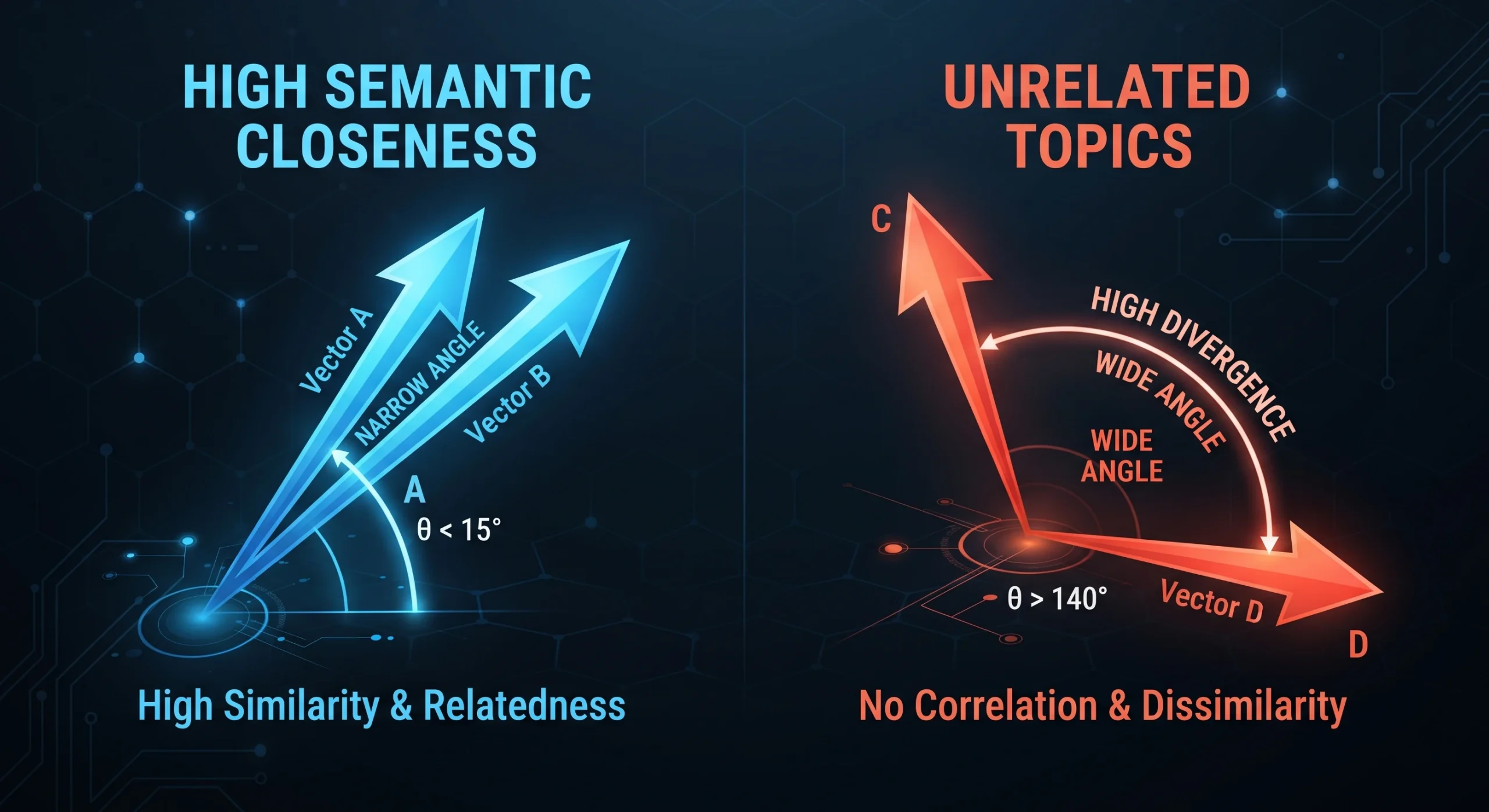
When a user submits a query to an advanced AI search assistant, the system converts that prompt into an embedding and searches for passages across the web that point in a similar directional angle.
When you build content using semantic clustering, you are essentially pre-packaging your information to match the exact mathematical retrieval patterns that AI engines use. By grouping tightly related concepts onto a single comprehensive page, you give the AI model everything it needs in one centralized location.
Traditional SEO vs. AI Search Clustering: A Strategic Comparison
To help clarify how your content strategy must shift, review the following comparison between legacy SEO clustering and modern AI semantic clustering:
- Traditional SEO Keyword Clustering:
- Structure: Pillar pages linked to narrow spoke pages.
- Intent: One keyword, one distinct intent per URL.
- Grouping Metric: SERP overlap and shared ranking domains.
- Outcome: Dispersed authority across dozens of thin, single-focus pages.
- AI Semantic Clustering:
- Structure: Comprehensive cluster pages that cover a core topic and all its supporting subtopics.
- Intent: Multiple related intents satisfied on a single URL.
- Grouping Metric: Vector embeddings and cosine similarity.
- Outcome: High topical authority and maximum extractability for AI citations.
Step-by-Step Workflow: How to Build Semantic Content Clusters
Transitioning your digital marketing strategy toward semantic clustering does not require a degree in data science. You can implement a practical, repeatable workflow today using modern semantic research tools.
1. Identify Your Seed Topic
Begin with a broad market category relevant to your business. Rather than picking a low-volume keyword, choose a comprehensive industry pillar (e.g., “creator marketing” or “technical SEO audits”).
2. Run Semantic Keyword Analysis
Instead of using standard keyword research software that groups by SERP overlap, utilize a semantic keyword tool such as KeywordsPeopleUse and navigate directly to their semantic keyword features.
- Enter your seed topic.
- Review the resulting queries, questions, entities, and conceptual terms that search engines treat as connected.
- Look at the Keyword Groups tab to see how the tool automatically categorizes distinct entities into logical buckets (such as digital marketing, attribution, and tooling).
3. Map Concepts to Comprehensive Pages
Once you have your semantic groups, do not spin off every single variation into its own micro-page. Instead, consolidate related questions that share a tight semantic angle onto a single comprehensive document.
For example, questions regarding creator outreach best practices, vetting standards, and sourcing methods naturally cluster together under a single comprehensive guide on finding and managing creators. Meanwhile, performance measurement metrics like KPIs and attribution form their own distinct semantic cluster and require a separate page.
Conclusion
The evolution of search requires marketers to look beyond exact-match keywords and embrace the mathematics of meaning. By structuring your content around vector embeddings, cosine similarity, and semantic depth, you align your website with the exact mechanisms AI search engines use to discover and cite information.
Do not let your strategy remain trapped in legacy SEO dogma. Build comprehensive semantic clusters, answer related queries thoroughly on a single page, and position your brand as the authoritative source that AI platforms trust and recommend.
Frequently Asked Questions About Semantic Clustering
Traditional keyword research is not entirely obsolete, but it is no longer sufficient on its own. While search volume data helps you understand overall market demand, semantic clustering ensures that the content you publish actually satisfies the complex retrieval patterns of modern AI models.
Semantic cluster pages are comprehensive by design because they cover a core topic alongside all its related sub-questions. Rather than writing to an arbitrary word count, focus on thoroughly answering every fan-out query associated with the topic so that AI search engines find complete answers within your document.
Once your cluster pages are live, you must connect them using bidirectional internal links with descriptive anchor text. This web of internal connections signals the structural relationship between your pages to AI crawlers, reinforcing your overall topical authority.

Rob is an SEO strategist and digital marketer who has been active in the search engine optimization industry since 2001. With over two decades of experience, he has witnessed the evolution of search from the early days of keyword stuffing to the modern era of AI-driven intent.
His expertise lies in technical SEO, content strategy, and authority building. He specializes in helping websites navigate complex algorithm shifts by focusing on high-quality, human-centric content and robust E-E-A-T principles. Throughout his career, he has successfully managed digital growth for a diverse range of industries – providing a grounded and historical perspective that few in the field possess.
When he is not analyzing search trends or optimizing site architecture, he is often traveling and exploring the outdoors.
Let’s Work Together
TELL US MORE ABOUT YOUR PROJECT
Let us help you get your website found. Or, if you simply have a few questions, then fill out the form below and we will get back to you.