
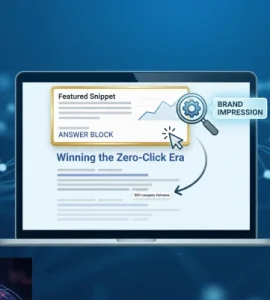
 The digital landscape is undergoing a seismic shift, fundamentally altering the relationship between search engines, content creators, and users. For decades, the primary objective of Search Engine Optimization (SEO) was straightforward: secure high rankings to drive traffic back to a website. However, Google and other search engines have evolved from mere directories into sophisticated answer engines. Today, a significant percentage of searches – some estimates suggest nearly two-thirds – end without a click. This is the “Zero-Click Era,” dominated by Featured Snippets, Knowledge Panels, and immediate “Answer Blocks” directly on the Search Engine Results Page (SERP).
For businesses accustomed to measuring success solely by site visits, this trend can feel frustrating. Yet, despair is unnecessary. The goal of SEO hasn’t disappeared; it has merely relocated. The new challenge is to provide immense value directly on the SERP, building authority even when the user doesn’t immediately convert into site traffic. As any forward-thinking Kelowna Search Engine Optimization firm which local businesses rely on will tell you, adapting to this new reality is not optional – it is essential for digital survival. Winning now means optimizing for visibility and authority before the click.
The Anatomy of a “Featured Snippet”: Structuring for Immediate Consumption
To win in the Zero-Click Era, you must understand the prize: “Position Zero.” This is the Featured Snippet box that appears above the traditional organic results, offering a concise, direct answer to the user’s query. Google programmatically pulls this information from a web page that it deems the most authoritative and clearly structured.
If you want your content to occupy this prime real estate, you must structure your data for immediate consumption by Google’s algorithms. You cannot bury the lead.
1. The Inverted Pyramid Writing Style:
Traditional content marketing often builds up to a conclusion. Snippet optimization requires the opposite. Start with the direct answer to the “who, what, where, when, or why.” If the query is “What is zero-click SEO?”, your first sentence should be a clear, definitive definition. You can elaborate on the nuances later in the content.
2. Formatting matters: Paragraphs, Lists, and Tables:
Google prefers different formats depending on the nature of the query.
- Paragraph Snippets: Best for definitions or short explanations (usually 40-60 words).
- List Snippets: Ideal for “how-to” guides, recipes, or “best of” queries. Use clear <h2> or <h3> tags for your list title, followed by numbered (<ol>) or bulleted (<ul>) lists.
- Table Snippets: Perfect for data comparisons, pricing structures, or specifications. Ensure your HTML table tags are clean and clearly labeled with headers.
3. The Role of Schema Markup:
While Schema (structured data) doesn’t guarantee a Featured Snippet, it acts as a translator for search engines. By wrapping your content in specific code, you explicitly tell Google, “This text is a recipe,” “This is an FAQ answer,” or “This is a product review.” Any competent SEO company in Kelowna has operating in the current market uses Schema to give their clients a competitive edge in clarifying content context to search engines.
Redefining Success: Brand Impressions vs. Website Visits
The biggest psychological hurdle in the Zero-Click Era is accepting that a lack of traffic doesn’t equal failure. We must broaden our definition of SEO success to include “Brand Impressions” on the SERP as a critical metric.
Why does appearing in an Answer Block matter if nobody clicks?
1. The Authority Signal:
When Google selects your content for Position Zero, it is implicitly endorsing your brand as the most trustworthy source on that topic. This is a massive psychological win. Even if the user just reads the snippet and leaves, your brand name is associated with the correct answer. You have established immediate credibility.
2. Digital Billboard Space:
Think of a Featured Snippet as a prime billboard on the busiest digital highway in the world. It takes up significant vertical space, pushing competitors further down the page – sometimes below the fold on mobile devices. This visibility is invaluable for top-of-funnel awareness.
3. The “Go-To” Effect:
If a user repeatedly sees your brand providing quick, accurate answers in their searches, they develop subconscious trust. When they eventually do have a more complex query requiring a deep dive or a purchase, your brand is already the established authority in their mind.
For example, a local user might search “best time to plant tomatoes in the Okanagan.” If a Kelowna garden center has optimized content, they might provide the answer (e.g., “Late May after final frost”) directly in the snippet. The user gets their answer and leaves. But come late May, when that user needs to buy tomato plants, who are they likely to visit? The brand that helped them months ago.
The Art of the “Cliffhanger”: Satisfy, Then Entice
While brand impressions are valuable, traffic is still crucial for conversions. The ultimate goal of zero-click optimization is to thread a needle: you must satisfy the user’s initial query sufficiently to win the snippet but leave enough unsaid to encourage a click for deeper details. This is the “cliffhanger” technique.
It is not about bait-and-switch. It is about providing the “what” while promising the “how” and “why” behind the click.
Technique 1: The Truncated List
If a user searches for “Top 10 SEO Strategies,” Google may pull a list snippet. If you structure your content correctly, Google might show the first five items in the snippet followed by a “More items…” link. You have provided value by listing the top five, but the user knows there are five more waiting on your site.
Technique 2: The Summary Table
For data-heavy queries, provide a summary table that answers the basic comparison. However, mention in the surrounding text that the full data set, encompassing more variables or historical context, is available in the full article. The snippet provides the snapshot; the click provides the analysis.
Technique 3: The Nuance Hook
Provide a direct answer but immediately qualify it with a hint of complexity. For instance, if the query is about a complex technical process, provide the definition, but follow it with a sentence like, “While this definition covers the basics, the implementation varies significantly depending on your specific platform setup (see step-by-step guide below).”
An experienced SEO company in Kelowna, such as Purpose Driven Promotion, will use this strategy to ensure that while local clients get brand visibility from simple queries, they also capture high-intent traffic from users looking for comprehensive solutions.
Conclusion
The Zero-Click Era is not the death knell of SEO; it is its maturity phase. It demands that we stop viewing search engines merely as traffic hoses and start viewing them as reputation management platforms. By optimizing for Answer Blocks through structured data and concise writing, appreciating the long-term value of SERP-based brand impressions, and mastering the art of the content cliffhanger, businesses can thrive in this new environment. The winners will be those who understand that sometimes, the most valuable click is the one you don’t get immediately, but the trust you earn permanently.
Frequently Asked Questions
It is a common fear, but statistics often show the opposite. While some very simple queries may result in fewer clicks, winning “Position Zero” usually leads to a much higher Click-Through Rate (CTR) than a standard #1 organic ranking because the listing is so prominent and visually engaging. You trade low-value clicks for high-visibility impressions, while often increasing high-value clicks.
Start with keyword research tools to identify keywords you already rank for on page one that currently trigger a Featured Snippet owned by a competitor. Analyze their snippet: Is it a paragraph, list, or table? Can you provide a more concise, accurate, or better-formatted answer? Also, look at “People Also Ask” boxes for question ideas.
No, it is not strictly required. Google is smart enough to extract answers from well-structured HTML (using proper headers, lists, and clear paragraphs). However, using Schema markup significantly increases your chances by making it unmistakably clear to Google what your content is about and how it is structured.
Yes, you can use the nosnippet meta tag on a specific page to prevent Google from using that content in a Featured Snippet. However, this is generally not recommended. If you opt out, a competitor will likely take that spot, gaining the brand visibility and authority that you forfeited.
Absolutely. While a Featured Snippet might not sell enterprise software, B2B buyers do extensive research. Appearing in Answer Blocks for technical definitions, comparison queries, or integration questions establishes your company as a knowledgeable industry leader early in their buying journey, building crucial trust.

Rob is an SEO strategist and digital marketer who has been active in the search engine optimization industry since 2001. With over two decades of experience, he has witnessed the evolution of search from the early days of keyword stuffing to the modern era of AI-driven intent.
His expertise lies in technical SEO, content strategy, and authority building. He specializes in helping websites navigate complex algorithm shifts by focusing on high-quality, human-centric content and robust E-E-A-T principles. Throughout his career, he has successfully managed digital growth for a diverse range of industries – providing a grounded and historical perspective that few in the field possess.
When he is not analyzing search trends or optimizing site architecture, he is often traveling and exploring the outdoors.
Let’s Work Together
TELL US MORE ABOUT YOUR PROJECT
Let us help you get your website found. Or, if you simply have a few questions, then fill out the form below and we will get back to you.