

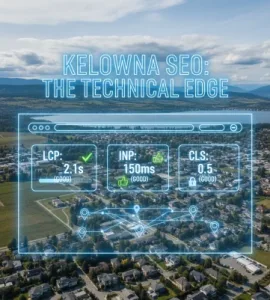
 The competition for attention in the Okanagan Valley is fierce, extending far beyond the storefronts of Bernard Avenue and into the digital realm. Every local business, from a boutique winery to a specialized legal firm, is fighting for visibility on Google. While every entrepreneur understands the importance of strong content and relevant keywords, many overlook the technical foundation that Google now prizes above all: user experience. Ignoring this foundation is costing Kelowna businesses revenue and rankings. For those seeking to excel with premium SEO services Kelowna, a focus on site speed and Core Web Vitals is not optional; it is the definitive technical edge.
This article will demystify the technical signals Google uses, explain how poor performance directly affects your company’s revenue, and offer practical, Kelowna-specific solutions to turn your website into a high-performance machine.
Understanding the Technical Shift in Kelowna Digital Marketing
For years, Search Engine Optimization focused primarily on what was on the page: keywords, backlinks, and content length. While these factors remain important, Google’s priority has profoundly shifted to how a user experiences that page. This transition reflects the reality of modern browsing, where most of the traffic is mobile, and user patience is nonexistent. A slow, unstable website delivers a poor experience, regardless of how well written the content may be.
Google’s response to this reality is the Page Experience signal, anchored by the three Core Web Vitals (CWV). These are a set of quantifiable, real-world metrics that measure load speed, responsiveness, and visual stability. Google has stated clearly that websites that perform well across these metrics are rewarded with better search visibility. For Digital Marketing in Kelowna, this is a critical distinction: technical performance is no longer a job for the developer alone; it is a fundamental pillar of search strategy.
Demystifying Core Web Vitals: The Three Pillars of Experience
Core Web Vitals are not abstract concepts. They are designed to measure specific moments in the user journey. Achieving a “Good” score for all three is essential for maintaining a competitive ranking position.
1. Largest Contentful Paint (LCP)
LCP measures the time it takes for the largest image element or block of text to become visible on the user’s screen. In simple terms, LCP answers the question: “When does the page actually feel loaded?”
- The Technical Goal: A “Good” LCP score is 2.5 seconds or less.
- The Simple Analogy: Think of LCP as the time it takes to serve a customer their main dish in a restaurant. If they order a burger at an Okanagan fast food restaurant and it takes five minutes just for the meal to appear, they are already upset, even if the food is perfect.
- Business Impact: LCP creates the first impression. If the hero image on your Kelowna real estate listing or the primary product photo on your e-commerce site takes longer than 2.5 seconds to appear, the user assumes the site is slow and will bounce (leave the site) before they have even processed your value proposition. Studies show that the probability of a user bouncing increases significantly as load time goes from one second to three seconds.
2. Interaction to Next Paint (INP)
(Note: Google is transitioning from First Input Delay, or FID, to INP. This new metric provides a more comprehensive measure of responsiveness throughout the user’s entire session.)
INP measures the delay between a user’s interaction (like clicking a menu link, tapping a button, or selecting a drop-down) and the time the browser visibly responds to that action. In simple terms, INP answers the question: “How responsive is the page when I try to use it?”
- The Technical Goal: A “Good” INP score is 200 milliseconds or less.
- The Simple Analogy: INP is like pressing the button for an elevator. If you press it and the button lights up instantly, you feel the system is working. If you press it and nothing happens for half a second, you might press it again, leading to confusion and frustration.
- Business Impact: INP is crucial for transactional pages. Consider a user trying to book a helicopter tour of the valley or add a gourmet coffee blend to their cart. If they click the “Book Now” or “Add to Cart” button and there is a noticeable delay, they may click multiple times or, worse, abandon the transaction altogether. Poor INP leads to lost sales and a sense of a lack of professionalism.
3. Cumulative Layout Shift (CLS)
CLS measures the total score of all unexpected layout shifts that occur while the page is loading. An unexpected layout shift is when an element moves without the user initiating it. In simple terms, CLS answers the question: “Does the content stay put?”
- The Technical Goal: A “Good” CLS score is 0.1 or less.
- The Simple Analogy: Imagine you are reading the menu board at a local brewery, and just as you go to point to your favorite craft beer, the entire sign unexpectedly drops a few inches because an ad banner loaded at the top. This is CLS.
- Business Impact: CLS directly leads to user frustration and mistakes. The classic e-commerce example involves a user clicking the wrong button – such as an ad or a different product – because a larger image or dynamic ad loaded above the button they intended to tap, pushing it out of the way. This damages user trust and kills conversions, making the site feel unreliable.
The Revenue Impact: Why Kelowna Businesses Must Care
Optimizing for Core Web Vitals is not just about making Google happy; it is a direct investment in conversion rate optimization (CRO). The metrics are clear:
- Lower Bounce Rates: A website that loads its main content (LCP) quickly experiences a much lower bounce rate. Customers stay, look around, and continue their journey.
- Increased Conversions: Research from Google and industry leaders has shown that even a one-second delay in page load time can lead to a significant drop in conversions, especially for e-commerce. For a Kelowna-based online specialty store generating $1,000 in sales per day, poor CWV can translate into tens of thousands of dollars in lost annual revenue.
- Mobile Shopper Retention: The Okanagan is a highly mobile market. People search for restaurants, services, and activities while on the go. If a mobile page is sluggish (poor INP) or jumps around (poor CLS), the user will simply click the back button and choose your competitor who offers a smoother experience.
It is simple: a fast, responsive, and stable website creates a sense of reliability and trust, which encourages visitors to complete the desired action, be it filling out a contact form or finalizing a purchase.
Practical, Kelowna-Specific Optimization Solutions
Improving Core Web Vitals often requires technical intervention, but the steps are actionable and deliver measurable results.
1. Choose a Local or Canadian Host to Reduce Latency
For a business focused on the Kelowna or broader Canadian market, the physical location of the web server is a factor in performance, specifically impacting LCP. Latency is the time it takes for a request to travel from a user’s browser to the server and back again. If your Kelowna-based server is in Texas, that round trip takes longer than if the server is located in Vancouver or even closer.
- Actionable Tip: Investigate Canadian web hosts or look for services that allow you to select a server location close to the Canadian border or on the West Coast. Reducing this physical distance is a simple, effective way to shave precious milliseconds off your LCP and Time To First Byte (TTFB).
2. Master Image Optimization: The Okanagan Scenery Hurdle
Kelowna is known for its stunning scenery, and local businesses naturally want to showcase large, beautiful images of vineyards, lakes, and mountain views. However, large, unoptimized image files are the number one killer of LCP.
- Actionable Tip: Always compress images using modern tools before uploading. Use next-generation formats like WebP. Crucially, implement responsive images, ensuring that a user on a mobile device does not download the massive desktop-sized image file.
3. Define Dimensions to Eliminate CLS Jumps
Unexpected layout shifts usually happen when the browser does not know the size of an element until it loads, causing the rest of the content to move suddenly.
- Actionable Tip: Always specify the width and height attributes for images and video players in your HTML. This reserves the necessary space immediately, preventing the content from shifting when the media finally renders. The same rule applies to embedding elements like map widgets or ad banners.
4. Optimize JavaScript for Better Responsiveness (INP)
Large, complex JavaScript files often block the main thread of the browser, which makes the site unresponsive and drives up INP.
- Actionable Tip: Defer or asynchronously load non-critical JavaScript. If a script (like a chat widget or analytics tracker) is not needed for the core function of the page, delay its loading until after the primary content has been rendered. Minimizing and removing unused code is also a vital step toward a faster, more responsive site.
Conclusion
For businesses striving for excellence in Digital Marketing in Kelowna and seeking high search engine rankings, the path to the top of Google’s results is paved with technical precision. Site speed and Core Web Vitals are not just background issues for IT – they are measurable, strategic components that directly impact customer behavior, trust, and ultimately, sales. By focusing on optimizing LCP, ensuring low INP, and eliminating CLS, Kelowna businesses can gain the competitive advantage needed to dominate the local search results and secure sustainable, long-term growth.
Frequently Asked Questions
The three main Core Web Vitals are Largest Contentful Paint (LCP), which measures loading speed; Interaction to Next Paint (INP), which measures responsiveness; and Cumulative Layout Shift (CLS), which measures visual stability. They matter for SEO services in Kelowna because Google uses these metrics as a fundamental ranking factor, meaning pages with poor scores are less likely to appear prominently in search results, regardless of how good their content is.
Poor LCP, which means the main content of the page takes longer than 2.5 seconds to load, directly hurts revenue by causing high bounce rates. Mobile users, especially, will often abandon a slow-loading site and choose a faster-loading competitor, resulting in lost sales, reservations, or lead generation opportunities before the user has even seen the product or service offering.
Yes, generally speaking, using a local or Canadian web host is better for site speed when your primary audience is local (i.e., in Kelowna). This is because local hosting reduces latency, the physical distance data must travel between the user and the server. Lower latency directly improves the server response time, which is a key factor in achieving a faster LCP score.
The simplest way is to use Google’s free PageSpeed Insights tool. Simply enter the URL of any page you want to test. The tool provides a clear breakdown of the LCP, INP, and CLS scores, along with an overall rating (Good, Needs Improvement, or Poor), based on data collected from real users.
Absolutely. Core Web Vitals are part of the overall page experience signal that Google uses to rank pages. When a customer performs a “Near Me” search (e.g., “winery near me Kelowna”), Google prioritizes pages that are not only relevant but also offer the best experience. A page with excellent CWV scores is more likely to be favored over a competing local business with a slow, unstable mobile site, giving the technical high-performer a decisive advantage.

Rob is an SEO strategist and digital marketer who has been active in the search engine optimization industry since 2001. With over two decades of experience, he has witnessed the evolution of search from the early days of keyword stuffing to the modern era of AI-driven intent.
His expertise lies in technical SEO, content strategy, and authority building. He specializes in helping websites navigate complex algorithm shifts by focusing on high-quality, human-centric content and robust E-E-A-T principles. Throughout his career, he has successfully managed digital growth for a diverse range of industries – providing a grounded and historical perspective that few in the field possess.
When he is not analyzing search trends or optimizing site architecture, he is often traveling and exploring the outdoors.
Let’s Work Together
TELL US MORE ABOUT YOUR PROJECT
Let us help you get your website found. Or, if you simply have a few questions, then fill out the form below and we will get back to you.